
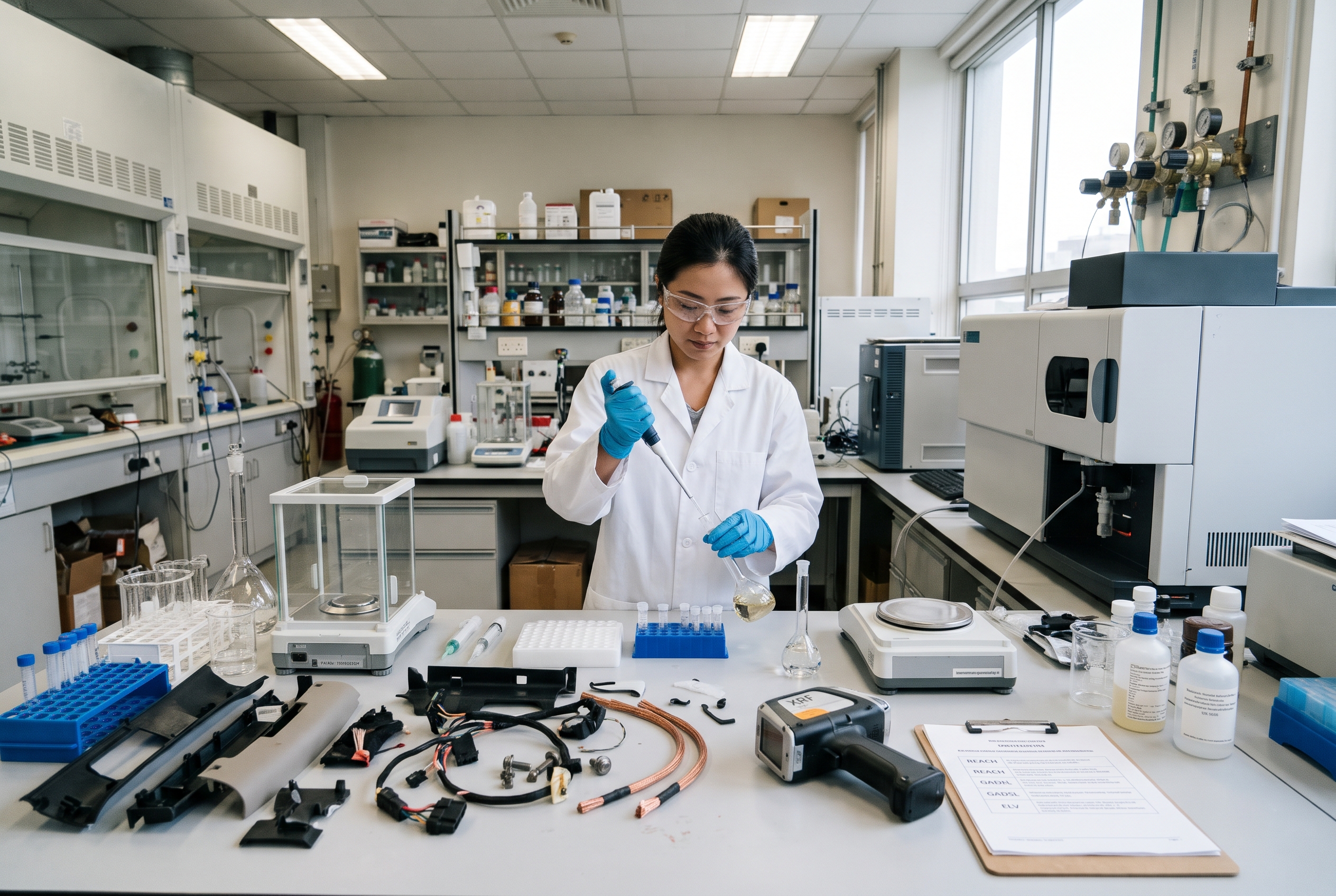
Modern passenger cars and commercial fleets incorporate thousands of distinct polymers, metallic fasteners, electrical cables, and surface coatings sourced across complex international supply networks. Beyond verifying physical endurance and crash safety, vehicle manufacturers must guarantee that every component complies with stringent global environmental directives restricting hazardous chemical substances. Automotive testing provides the accredited chemical analysis protocols required to detect and quantify prohibited heavy metals, toxic plasticizers, and regulated flame retardants inside raw materials and finished vehicle parts. Conducting objective laboratory verification protects assembly plants from sudden customs holds, regulatory fines, and costly supply chain rejections.
Relying solely on unverified paper declarations from upstream material vendors exposes automakers to severe compliance risks. Independent analytical screening transforms regulatory reporting into verifiable laboratory proof that satisfies global vehicle export legislation.
Key Restricted Substances Screened in Automotive Materials
International environmental frameworks such as the European End of Life Vehicles Directive, REACH, and Global Automotive Declarable Substance List enforce tight concentration thresholds across several primary chemical groups.
- Regulated Heavy Metals and Hexavalent Chromium: Analytical laboratories utilize Inductively Coupled Plasma Optical Emission Spectrometry and colorimetric spectrophotometry to measure trace concentrations of lead, cadmium, mercury, and hexavalent chromium across metal plating baths, brass fittings, wheel balance weights, and corrosion resistant fastener coatings.
- Phthalate Plasticizers and Polycyclic Aromatic Hydrocarbons: Soft touch vinyl trims, wiring harness jackets, rubber floor mats, and elastomeric door grips frequently rely on chemical softening agents and extender oils. Gas chromatography mass spectrometry isolates restricted phthalates and carcinogenic polycyclic aromatic hydrocarbons that can migrate through skin contact during daily driving.
- Brominated Flame Retardants and Persistent Organic Pollutants: Seat fabrics, dashboard foams, and molded electrical connectors require fire resistance without relying on banned polybrominated diphenyl ethers or persistent fluorinated chemicals. Targeted extraction confirms that alternative fire retardant formulations remain both chemically compliant and thermally effective.
Supply Chain Segments Relying on Chemical Compliance Verification
Accredited restricted substance screening safeguards international market access and corporate sustainability targets across diverse automotive manufacturing tiers.
- Tier One and Tier Two Component Fabricators: Suppliers populating the International Material Data System rely on certified laboratory reports to document exact alloy compositions and verify that stamped hardware, molded plastics, and painted brackets contain zero banned additives.
- Wiring Harness and Automotive Cable Producers: Flexible copper harnesses utilize specialized polyvinyl chloride insulation, heat shrink tubing, and solder terminations that must satisfy overlapping automotive and electronic chemical safety mandates.
- Metal Plating and Surface Conversion Job Shops: Electroplating operations transitioning from legacy hexavalent chromium coatings to compliant trivalent chromium passivations depend on batch level laboratory checks to confirm zero residual chemical contamination from shared process tanks.
- Export Oriented Vehicle Assemblers and Importers: Regional manufacturing hubs shipping complete built up vehicles and replacement spare parts into Europe, Japan, North America, and ASEAN markets maintain routine chemical compliance audits to ensure uninterrupted border clearance.
Proving full chemical compliance across every nut, wire, and molded panel safeguards human health while keeping global vehicle production schedules on track. By scheduling accredited automotive testing through Alstesting automotive testing services in Malaysia, component suppliers and regional automakers obtain internationally recognized analytical certificates to satisfy strict environmental directives across Southeast Asia and global export destinations.
Frequently Asked Questions (FAQ)
Why is hexavalent chromium strictly restricted in automotive metal plating?
Hexavalent chromium was historically prized for creating durable, self healing corrosion barriers on steel bolts and chassis brackets, yet it is a potent human carcinogen and severe environmental toxin. Global automotive regulations restrict its use to protect factory plating workers and prevent toxic heavy metal leaching when end of life vehicles are recycled or shredded.
How does laboratory chemical testing support International Material Data System reporting?
The International Material Data System requires automotive suppliers to declare every basic substance present inside a delivered component down to defined weight thresholds. Accredited laboratory testing validates supplier chemical safety sheets empirically, catching undeclared impurities or accidental material substitutions before formal data submission to the automaker.
What is the difference between XRF screening and wet chemistry ICP analysis for heavy metals?
Handheld X ray fluorescence provides rapid, nondestructive surface screening to flag the presence of total elemental chromium, lead, or cadmium in seconds. Wet chemistry acid digestion followed by Inductively Coupled Plasma analysis dissolves the entire homogenous specimen to deliver far higher quantitative precision and distinguish safe trivalent chromium from prohibited hexavalent chromium.


